Getting your child ready for kindergarten raises one big question: what do they actually need to know? The answer goes beyond academics. Readiness is really about confidence, curiosity, and a handful of everyday skills. Most parents focus on early reading, but that’s only one piece. The National Center for Education Statistics tracks how often young children take part in developmental activities at home, and the picture is uneven: many are read to often, yet other skill-building routines get far less attention. A well-rounded approach works better.
Educational apps have become a practical tool for busy families. The kids’ educational app market is growing fast, and Grand View Research projects continued expansion through 2030. Good apps give children structured, playful practice on the exact skills they’ll use in class. This guide breaks down nine kindergarten readiness skills and simple ways to build each one at home.
| App | Key Focus | Age Range | Core Skills Covered | Offline Access |
|---|---|---|---|---|
| Learning App for Kids | Play-based curriculum | 2-8 | Reading, math, SEL, creativity | Yes |
| ABCmouse.com | Step-by-step learning path | 2-8 | Reading, math, science, art | Yes |
| Khan Academy Kids | Free, comprehensive curriculum | 2-8 | Reading, math, logic, SEL | Yes |
| Homer | Personalized reading pathway | 2-8 | Reading, math, creativity | Yes |
| Noggin | Interactive learning with TV characters | 2-7+ | Math, literacy, wellness | Yes, with downloads |
1. Social & Emotional Development
Social and emotional learning (SEL) is the foundation of a strong kindergarten start. Your child needs to manage feelings, follow a teacher’s directions, share, and take turns. Kids with these skills make friends faster and settle into classroom routines with less stress. That security frees them up to learn.
How to practice at home:
- Play board games: Simple games teach rules, turn-taking, and how to handle winning and losing.
- Use feeling words: Label emotions out loud. Saying “I see you are frustrated” or “You seem happy” builds emotional vocabulary.
- Role-play scenarios: Act out school moments, like asking another child to play or waiting for a toy someone else is using.
The Learning App for Kids uses character-driven stories that model sharing, empathy, and cooperation, so children see these behaviors in action.
2. Language & Literacy Skills
Strong language skills predict academic success. Your child doesn’t need to read fluently before kindergarten. They do need the building blocks: recognizing some letters, especially in their own name, knowing that stories have a beginning, middle, and end, and hearing the sounds inside words. That last skill is called phonological awareness.
How to practice at home:
- Read together daily: Make reading a cozy routine. Point to words as you go and ask about the story and pictures.
- Talk about your day: Ask your child to share details about their experiences. This builds vocabulary and narrative skills.
- Sing songs and nursery rhymes: These help children hear rhythm and rhyming sounds in language.
Interactive storybooks and phonics games in Learning App for Kids turn pre-reading practice into an adventure, with activities that adapt as your child grows.
3. Math & Numeracy Skills
Early math goes beyond memorizing numbers. It covers quantity, size, and patterns. A kindergarten-bound child benefits from counting to ten, naming basic shapes, sorting by color or size, and grasping ideas like more and less. Classrooms use these concepts daily, from counting classmates to sorting supplies.
How to practice at home:
- Count everything: Count steps as you walk, snacks on a plate, or toys in a box. Make counting part of the day.
- Go on a shape hunt: Spot circles, squares, and triangles at home or on a walk. “The clock is a circle! The window is a square!”
- Sort laundry or toys: Ask your child to match socks by color or split small and large blocks into separate bins.
Learning App for Kids offers hundreds of number puzzles, counting games, and shape-sorting challenges that make core math feel like play.
4. Fine Motor Skills
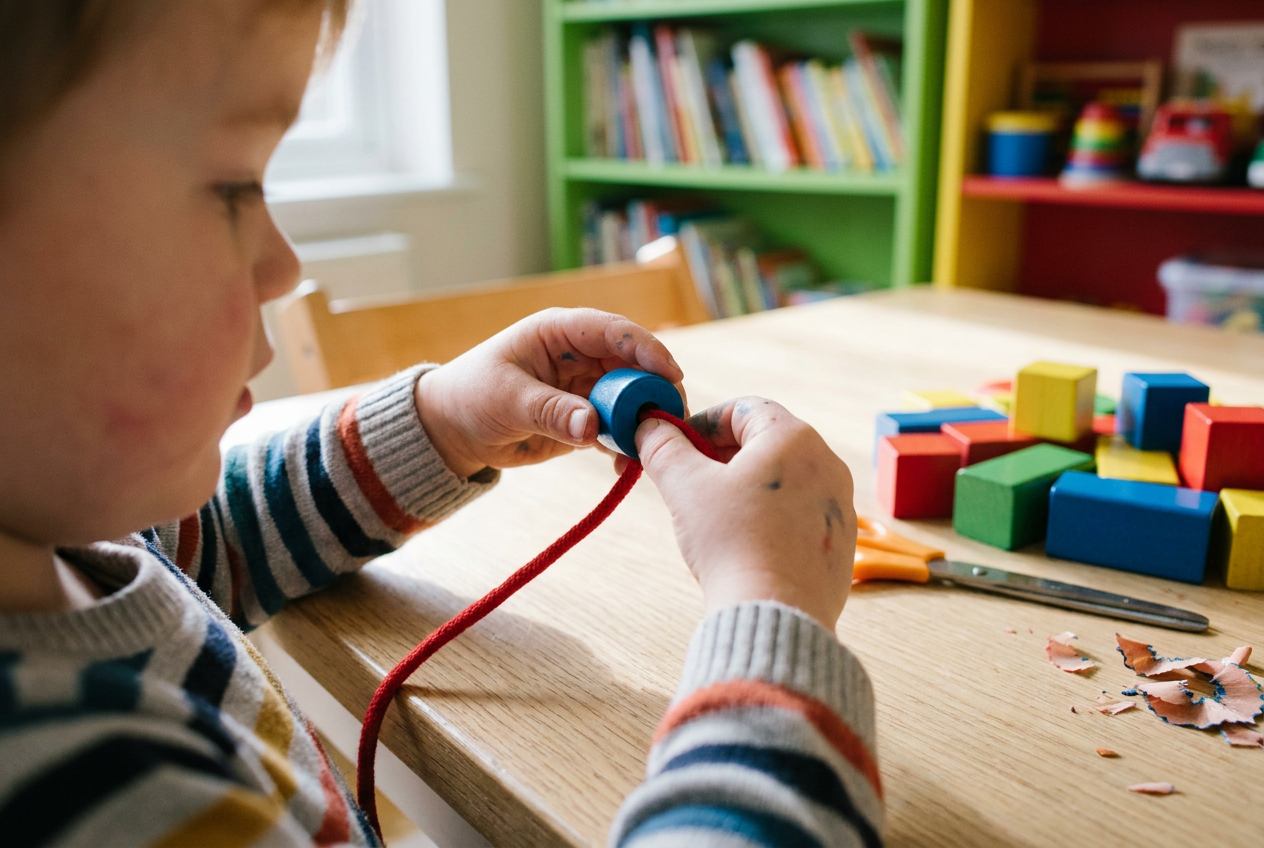
Fine motor skills use the small muscles in the hands and fingers. Your child relies on them to hold a pencil, use crayons and scissors, and fasten buttons or zippers. Good control builds independence and lets kids join art projects and early writing with confidence.
How to practice at home:
- Play with dough: Squeezing, rolling, and shaping play-dough is a great workout for hand muscles.
- Use child-safe scissors: Let your child cut lines and simple shapes on paper, with supervision.
- Build with blocks: Stacking blocks and LEGOs improves hand-eye coordination and precision.
Our tracing games and digital coloring activities build the finger and wrist control writing requires, right on the screen kids already love.
5. Gross Motor Skills
Gross motor skills use the large muscles for walking, running, jumping, and climbing. Your child needs them on the playground, in gym class, and just moving around a busy room. They also support coordination, body awareness, and overall health.
How to practice at home:
- Visit a playground: Climbing, swinging, and sliding build strength and coordination.
- Have a dance party: Put on music and move. Dancing works on balance and coordination.
- Play catch: Tossing a soft ball back and forth builds hand-eye coordination and whole-body movement.
A screen can’t replace real movement, so Learning App for Kids includes brain-break videos with guided stretches and simple exercises that get kids up and moving.
6. Cognitive Skills & Problem-Solving
Cognitive skills are the mental tools your child uses to think, learn, and solve problems. A kindergartener follows two- or three-step directions, understands cause and effect, and uses simple logic to work through puzzles. These skills anchor every academic subject and help children make sense of the world.
How to practice at home:
- Play matching and memory games: These classics boost working memory and pattern recognition.
- Ask “what if” questions: Pose simple hypotheticals during play or reading. “What if the wolf had been friendly?”
- Do puzzles together: Jigsaw puzzles teach children to spot patterns and reason about how pieces fit.
Learning App for Kids is packed with puzzles, sorting games, and logic challenges that strengthen these skills while it still feels like play.
7. Self-Help & Independence
Kindergarten teachers value students who handle basic needs on their own. That means using the bathroom, washing and drying hands, putting on a coat and shoes, and keeping track of a backpack and lunchbox. Independence builds confidence and lets teachers focus on teaching.
How to practice at home:
- Create a “get ready” routine: Practice the steps for leaving the house and let your child do as much as they can alone.
- Assign a simple chore: Putting toys away or setting a plate in the sink builds a sense of capability.
- Label their belongings: Help them find their name on a backpack, lunchbox, and jacket so they spot their items at school.
Our app focuses on academic skills, but the confidence kids gain from solving problems here carries into an “I can do it!” attitude everywhere.
8. Creative Expression & Arts
Creativity isn’t about being good at art. It’s about thinking flexibly, imagining possibilities, and expressing ideas. Drawing, singing, and pretend play help children process experiences and share their thoughts. Kindergarten overflows with these moments, and comfortable kids dive right in.
How to practice at home:
- Keep art supplies handy: Store crayons, paper, markers, and chalk where your child can reach them. Focus on the process, not the result.
- Engage in pretend play: Use puppets, dress-up clothes, or old boxes to build imaginary worlds. Join in and let your child lead.
- Sing and make music: Sing familiar songs and invent new ones. Shakers or pots and pans work fine for exploring rhythm.
The digital art studio in Learning App for Kids gives children a mess-free space to draw, paint, and create with a full set of colors and tools.
9. Curiosity & Eagerness to Learn
The most important readiness skill might be the simplest: a love of learning. A curious child who asks questions and tries new things is set up to thrive. This one is less about knowledge and more about attitude, a habit of discovery that pays off across every school year.
How to practice at home:
- Encourage questions: When your child asks “why,” treat it as a chance to explore. Look up answers together in a book or online.
- Explore new places: Visit a museum, park, or library. New experiences spark curiosity and give you fresh things to talk about.
- Celebrate effort, not just correctness: Praise hard work on a puzzle or a good question, even when the answer isn’t right.
Our app sparks that curiosity. Fresh characters, worlds, and challenges pull children in to explore, experiment, and discover, building real motivation to learn.
Challenges Parents Face When Preparing a Child for Kindergarten
Building these nine skills is rewarding, but most families run into the same sticking points along the way. Naming them makes each one easier to handle.
- Balancing screen time: Parents worry about how much time on a device is healthy and whether it crowds out hands-on play. The fix is to treat an app as one short, purposeful part of the day, not a replacement for blocks, books, and outdoor time.
- Telling real learning from “just a game”: It is hard to know whether an app teaches anything or simply entertains. Look for activities tied to specific skills, progress that adapts to your child, and content reviewed by early-childhood educators, like the practice built into Learning App for Kids.
- Gauging where your child stands: Many parents want a clear way to measure readiness. Rather than a single test, watch for steady progress across the nine skills above and check in with your child’s preschool teacher, who sees these benchmarks every year.
How to Put Your Kindergarten Readiness Checklist Into Practice at Home
You don’t need flashcards or formal lessons to build these nine skills. Weave simple, playful activities into your daily routine instead. Aim to grow a love of learning and steady confidence, not pressure. A few principles keep you on track:
- Focus on play: Children learn best through play. Board games, pretend play, and outdoor activities are powerful tools.
- Keep it positive: Celebrate effort and progress. Frame mistakes as learning. Your encouragement is your child’s biggest motivator.
- Follow their interests: Loves dinosaurs? Count and read about dinosaurs. Loves cars? Sort them by color. Interests make learning effortless.
- Balance activities: Mix active play, quiet time, creative work, and social time. A quality educational app adds targeted practice in key academic areas.
Give your child a head start. Explore hundreds of games, stories, and activities in Learning App for Kids built to grow every skill on this checklist. Download the app today and watch their confidence take off. Curiosity about the device itself usually arrives with school. What a computer is is a good first answer to keep in your pocket.
When your child is past the checklist, the five year old guide covers blending and the first number facts, which is where the year actually goes.
Frequently Asked Questions (FAQs)
What is the most important kindergarten readiness skill?
All nine matter, but many educators point to social and emotional skills as the most critical. A child who follows directions, manages feelings, and gets along with peers has the foundation to take part in class and absorb academic lessons.
How can I tell if my child is ready for kindergarten?
Look for a general mix of the skills above, not mastery in one area. Weigh independence, curiosity, and how your child interacts with others. Your child’s preschool teacher is a great resource, since they know kindergarten readiness benchmarks firsthand.
Do I need to teach my child to read before kindergarten?
No. Your child doesn’t need to read fluently. Pre-literacy skills still help a lot: recognizing letters, knowing some letter sounds, and enjoying being read to. These prepare children for formal reading instruction at school.
What if my child is behind in one of these areas?
Children develop at different paces, and that’s normal. If you notice a gap, add more low-pressure, playful practice in that skill. For bigger concerns, talk with your pediatrician or your child’s preschool teacher.
Are learning apps a good way to prepare for kindergarten?
They can be, when the app promotes active, adaptive learning rather than passive watching. The debate over screen time is fair, so quality matters more than quantity. Look for apps that give hands-on practice with letters, counting, and problem-solving, adapt to your child’s level, and complement real-world play instead of replacing it. Learning App for Kids is built this way, pairing structured practice with playful discovery.
Give the Learning App for Kids a try — it's free
Ad-free, bilingual lessons + a free AI tutor, on web, Android and iPhone.