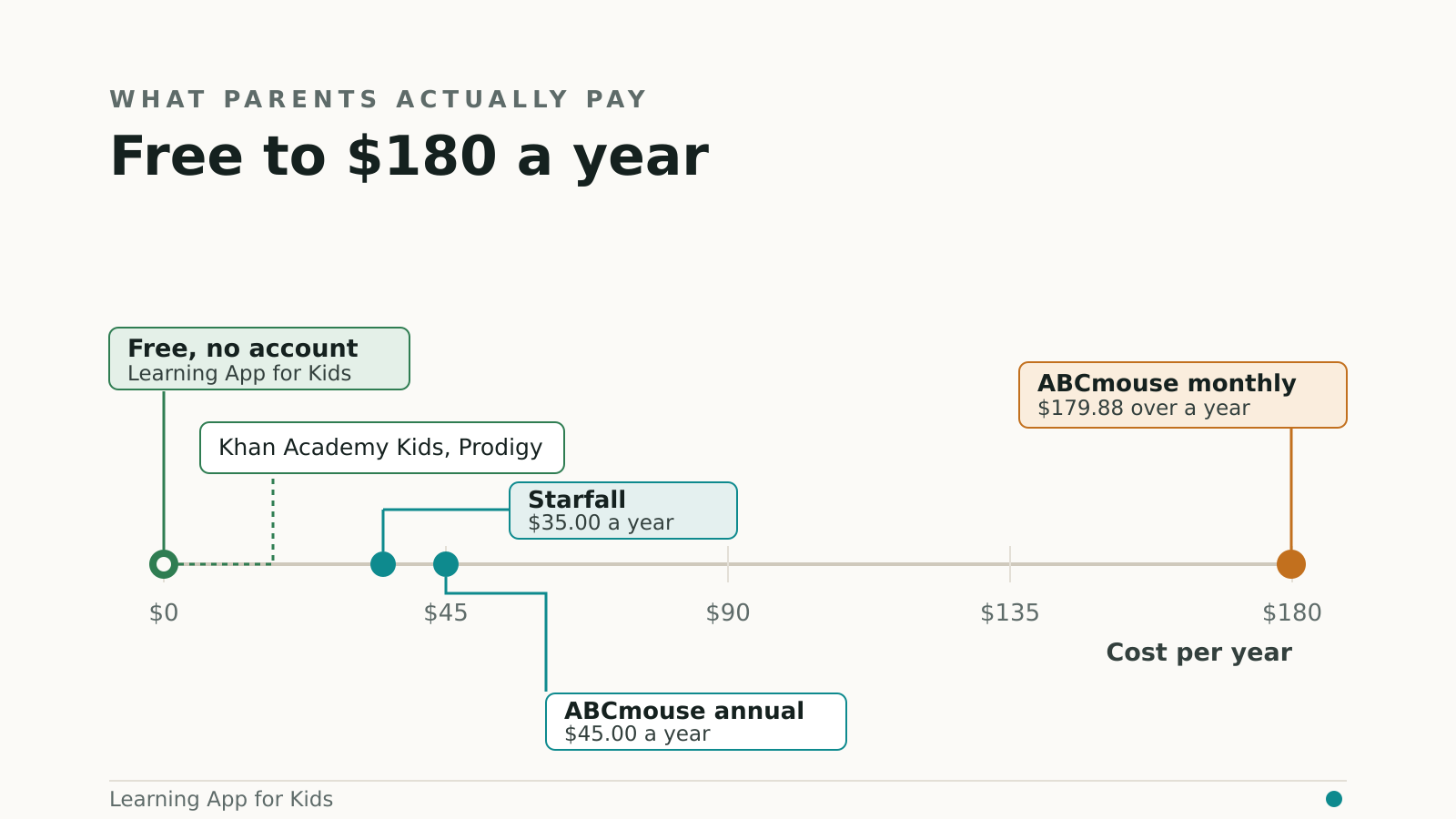
Children's learning apps advertise a monthly price and earn most of their money from families who never switch to the annual one. On ABCmouse the gap is $14.99 a month against $45.00 a year, which is a four times difference for identical access.
Below is what the main options actually cost, what each gives away free, and the three things that decide the number on your statement. Every figure here was read from the provider's own page rather than a review site, and where a current price could not be confirmed, no number is quoted. Children notice prices too. How buying online works is a useful thing to read together before the next upgrade prompt appears.
What each app costs
| App | Cheapest full access | Free tier | Ads | Sign up |
|---|---|---|---|---|
| Learning App for Kids | Free | Everything is free | None | Not required |
| Khan Academy Kids | Free | Everything is free | None | Account required |
| Prodigy Math | Free for maths and English | Maths and English content | None | Account required |
| Starfall | $35.00 a year | Some content free | None | Account required |
| ABCmouse | $45.00 a year | 10 activities a day | None | Account required |
Three things that decide what you actually pay
The plan you land on
Monthly is almost always the default path through a signup flow, and nothing later prompts a switch to annual. A family that starts monthly usually stays monthly, which on ABCmouse means $179.88 a year instead of $45.00.
Where you subscribe
Subscribing through an app store rather than the provider's website can change the renewal price. ABCmouse annual renews at $45.00 on the web and can renew at $59.99 through an app store, for the same content.
Whether a trial converts
Free trials attach to specific plans and specific signup routes. ABCmouse offers 30 days, but only on the monthly plan and only on web signup. A missed cancellation charges the full term, and these subscriptions are typically prepaid and non refundable.
What the free options genuinely cover
Free does not mean limited here. Khan Academy Kids is free with no ads and no subscriptions across ages 2 to 8. Prodigy gives away its maths and English content and charges for science and extras. Our own lessons are free with no account at all, work offline once installed, and run from Playgroup to Grade 5 in both English and Urdu.
ABCmouse also has a free tier, capped at 10 learning activities a day on one child profile. The cap resets daily, which makes it usable long term for a child whose routine is short and daily. We break down every ABCmouse plan in how much ABCmouse costs.
What "free" can actually mean
Free covers several very different arrangements, and the differences matter more than the price does.
Free with no catch
The whole product is free, with no advertising and nothing to buy. Khan Academy Kids and our own lessons work this way. Ask who funds it: a non profit, a grant, or a parent company treating it as outreach are all durable answers.
Free tier with a ceiling
A genuine free level with a limit, such as ABCmouse's 10 activities a day. These are honest if the limit is stated clearly, and often perfectly workable for a short daily routine.
Free to install, paid to progress
The download costs nothing and content unlocks with purchases. This is the arrangement worth checking most carefully before handing a child a device, because the cost is unbounded and the prompts sit inside the child's experience rather than the parent's.
Free because your data pays
Advertising supported apps are free at the till. For children's software this deserves proper scrutiny of the privacy policy, and it is the main reason an app that asks for no account at all is worth something.
Costs that do not appear on the price page
Two families paying the same headline price often pay very different amounts. Check whether a subscription covers one child profile or several, because per child pricing changes the total sharply for siblings. Check whether the plan you are buying includes everything you saw advertised, since some catalogues split content across tiers. And check the renewal price rather than the introductory one, which is where the largest surprises sit.
When paying is genuinely the right call
There are three situations where a subscription earns its money. The first is when one child needs a broad structured path across many subjects and you do not want to assemble it yourself, which is what the larger paid catalogues are built for. The second is when your child has locked onto one specific app and will actually use it, since the best app is the one that gets opened. The third is when a paid tier removes a genuine blocker, such as offline access on a long commute or a sibling profile that stops two children overwriting each other.
Outside those cases, the free options in this comparison cover most of what a primary aged child needs, and the money is better spent on books.
Start free, and pay only when you hit a real wall
Test the free options first for two weeks. They cost nothing, and the common outcome is that a child settles on one and the question of paying never arises. If you do hit a wall, you will know exactly what you are buying rather than guessing.
When you do subscribe, take the annual plan on the provider's own website and set a calendar reminder before it renews. Those two steps prevent nearly every way families overpay for children's software.
You can start with any of our free lessons right now. There is no account, no advertising, and nothing to cancel.
Knowing the prices is the first half. Whether any of it is worth paying is the second, and we set out exactly what a subscription buys that free does not.
Frequently Asked Questions (FAQs)
How much do children's learning apps cost?
The paid ones in this comparison run from $35.00 a year for Starfall to $45.00 a year for ABCmouse on their annual plans. Monthly billing is far more expensive: ABCmouse monthly is $14.99, which is $179.88 over a year for the same access.
Are any children's learning apps completely free?
Yes. Khan Academy Kids is free with no ads and no subscriptions for ages 2 to 8. Learning App for Kids is free with no account required and works offline. Prodigy's maths and English content is free to play.
Why is the monthly price so much higher than the annual price?
Annual plans are discounted heavily to secure a year of commitment. On ABCmouse the annual plan is $45.00 against $179.88 for twelve monthly payments, a four times difference for identical access.
Do free learning apps show adverts to children?
The apps in this comparison do not. That is worth checking individually before installing anything, because some free children's apps fund themselves through advertising or in app purchases instead.
Is a paid app better than a free one?
Not automatically. Paid apps tend to offer a broader single path across many subjects. Free apps are often narrower and better at one thing. Match the app to what your child is actually stuck on rather than to the price.
What should I check before subscribing to any of them?
Multiply the monthly price by twelve and compare it against the annual price, check whether you are subscribing through the web or an app store because renewal prices can differ, and set a reminder before any free trial ends.
Which app is best for a bilingual child?
Look for one that teaches in both languages rather than translating the interface. Learning App for Kids carries every lesson in English and Urdu, which lets a child meet a concept in whichever language is stronger.