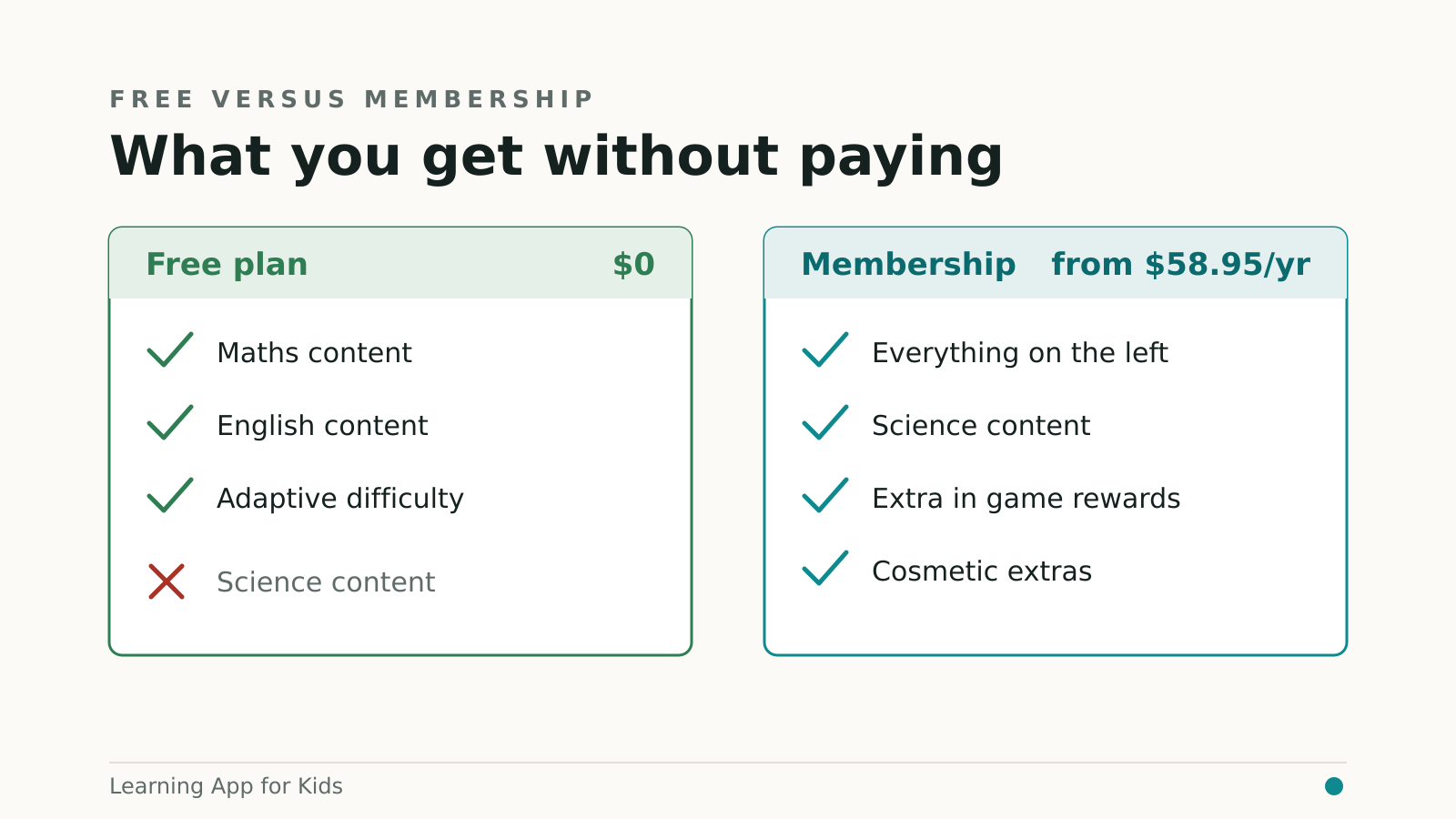
Yes. Prodigy's maths and English content is free, and a child can play through the maths curriculum without anyone entering a card. That is the short answer, and it is genuinely the case rather than a trial that expires.
The longer answer is where families get confused. Prodigy sells memberships from $58.95 a year, the game pushes them fairly hard in the interface, and a child who wants the rewards behind them will ask. Knowing exactly what the money buys makes that conversation much easier.
What is free and what is paid
| What you get | Free | Core | Plus | Ultra |
|---|---|---|---|---|
| Maths content | Yes | Yes | Yes | Yes |
| English content | Yes | Yes | Yes | Yes |
| Science content | No | Yes | Yes | Yes |
| In game rewards and extras | Limited | More | More again | Most |
| Price, billed annually | $0 | $58.95/yr | $88.95/yr | $118.95/yr |
Read the science row carefully. It is the one genuine content difference. Everything else a membership adds is enhancement rather than curriculum, which means a child using Prodigy purely for maths practice is not missing lessons by staying on the free plan.
Where the free version runs out
The free plan is not limited by time, lesson count or difficulty level, which is unusual and worth saying plainly. What it is limited by is motivation. Prodigy is built as a game, and a large part of the game loop is earning and equipping rewards. Many of those sit behind a membership.
For some children that is irrelevant and the maths carries the interest on its own. For others the locked rewards become the reason they stop playing, and a parent then faces a choice between paying and finding something else. Neither outcome is a fault in the product, but it is the practical ceiling on the free plan, and it arrives through motivation rather than through content.
The second limit is scope. Prodigy is a maths game with English alongside it. A child who needs phonics from the beginning, or reading practice in a second language, needs something built for that instead.
How Prodigy compares on price
Against the wider field, Prodigy's free tier is one of the more generous. Khan Academy Kids is fully free with no ads or subscriptions for ages 2 to 8. Our own lessons are free with no account at all. Paid options such as ABCmouse sit at $45.00 a year on the annual plan, which is roughly $14 less than Prodigy Core, though the two are aimed at different ages and teach very differently.
We set out the full picture, including where each app hides its costs, in our guide to what ABCmouse costs.
How Prodigy teaches, and who it fits
Prodigy wraps maths questions inside a role playing game. A child explores a world, meets characters, and answers questions to win encounters. The questions adapt to how the child is performing, so a run of correct answers raises difficulty and a run of errors lowers it.
That design suits a particular child: one who already reads well enough to follow the game, who has the basic arithmetic to attempt the questions, and who is motivated by progression and collection. For that child it turns practice volume into something they choose to do, which is the hardest problem in primary maths.
It suits a different child much less. A six year old still counting on fingers spends more attention on the game than the maths, and a child who cannot yet read the question fluently is blocked by reading rather than by number. Prodigy is a practice tool, not a teaching tool, and it works best on foundations that already exist.
What to watch for with reward driven games
The mechanic that makes Prodigy motivating is the same one that produces requests to upgrade. Rewards are visible, some are locked, and the child can see exactly what a membership would unlock. That is ordinary game design rather than anything underhand, but it changes the conversation at home.
Two things help. Decide in advance whether a membership is on the table, and say so plainly, because an open question invites repeated asking. And separate the maths from the rewards when you talk about progress: ask what they worked out, not what they unlocked. A child who measures a session by items collected will lose interest the moment collecting stalls.
It is also worth checking playtime. Adaptive questioning means a long session is not necessarily a productive one, since a child can settle into a comfortable difficulty band and stay there. Fifteen focused minutes usually does more than an hour of drifting.
Getting real value from the free plan
If you stay on the free plan, a few habits make it work considerably harder.
Set the grade level deliberately rather than leaving it to default. Prodigy adapts, but it adapts from wherever it starts, and a level set too high produces guessing while one set too low produces boredom. Check it after the first week and again after a month.
Sit with your child for the first two or three sessions. You are not supervising the maths so much as learning what the game rewards, which tells you how to read their reports later. It also lets you spot the difference between a child who is thinking and one who is clicking through encounters.
Watch for a plateau. Adaptive systems settle children into a comfortable band, and a child can play happily for weeks without meeting anything new. If the questions look the same in week six as in week two, pair the game with something more directed for a while.
Finally, keep sessions short. The game is designed to be open ended, and open ended play is where practice quality drops. Twenty minutes with a clear finish beats an unbounded afternoon.
Decide by what your child is stuck on
If your child is fluent enough to enjoy a maths battle game and simply needs practice volume, the free Prodigy plan does that job and the membership is optional. If they are still building number bonds or times tables, a game will not fix a recall gap, and short focused practice will move them faster.
That is the case our own free maths lessons are built for: no account, no rewards to unlock, and a few minutes a day from Playgroup to Grade 5.
Every lesson on Learning App for Kids is free, needs no sign up, carries no advertising, and works offline. A paywall is worth explaining rather than hiding. How paying for things online works does it without scaring anyone.
Prodigy is one of sixteen apps in our price and features table, where six of the companies turn out to publish no price at all.
Frequently Asked Questions (FAQs)
Is Prodigy Math free?
Yes. Prodigy's maths and English content is free to play without a membership. A paid membership adds science content and extra in game features, priced from $58.95 a year when billed annually.
What does a Prodigy membership actually add?
Science content and game enhancements such as additional rewards and cosmetic extras. The maths curriculum itself is available on the free plan.
How much does Prodigy cost?
Billed annually, Core is $58.95 a year, Plus is $88.95 a year and Ultra is $118.95 a year, which work out at $4.91, $7.41 and $9.91 a month.
Is a Prodigy membership worth it for maths practice alone?
If maths is the goal, the free plan already carries the maths content. A membership mainly buys science and in game extras, so it is worth paying for when your child wants those rather than when they need more maths.