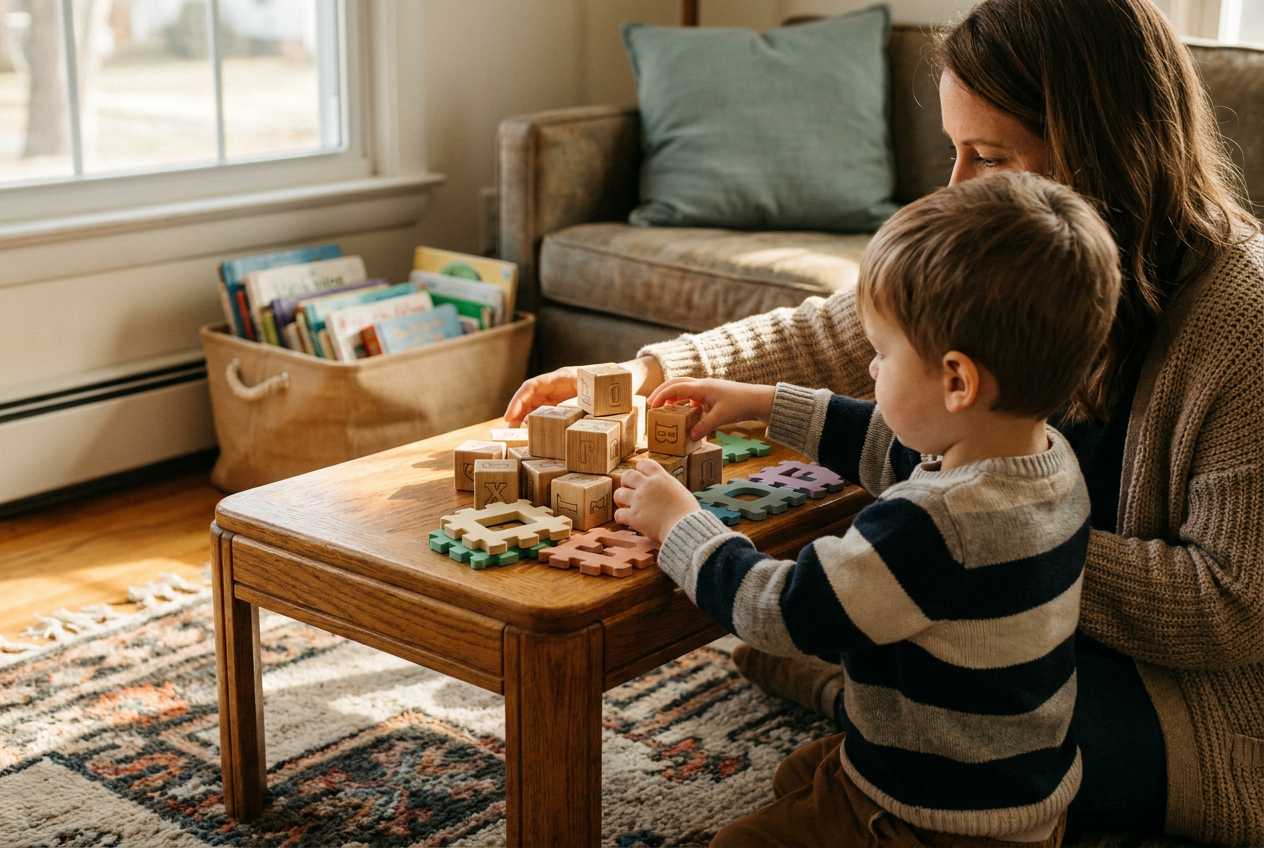
The first time your preschooler sounds out a word on their own, it feels like magic. Getting to that moment is where many parents freeze, unsure how to teach reading or even where to start.
Here is the good news. You do not need a teaching degree to give your child a strong start. A simple, playful routine gets the job done, and the payoff is real. Early reading skill is one of the strongest predictors of later school success. Data from the National Center for Education Statistics shows that 37 percent of U.S. fourth-graders read below the basic level, and that gap often traces back to the preschool years.
Start early and keep it fun. A child’s first experiences with language and stories lay the groundwork for everything that follows. The American Academy of Pediatrics reports that promoting literacy from infancy improves school readiness and builds language and social-emotional skills. Introduce the building blocks of phonics through games and daily routines, and you set your child up for confident reading. This guide gives you a simple, step-by-step plan that turns a big task into playtime you both enjoy.
| App | Primary Focus | Age Range | Learning Method | Free Content |
|---|---|---|---|---|
| Learning App for Kids | Personalized phonics and reading path | 2-8 | Gamified, adaptive curriculum | Free trial available |
| ABCmouse | Comprehensive curriculum (reading, math, science) | 2-8 | Structured path, tickets and rewards | Subscription, limited free access |
| Homer | Personalized reading instruction | 2-8 | Interest-led, skill-building activities | Subscription, free trial |
| Khan Academy Kids | Core subjects through creative play | 2-8 | Story-driven, character-guided lessons | Completely free |
| Starfall | Phonics-based reading and math | Pre-K to 3rd grade | Song- and game-based learning | Extensive free content, optional membership |
Learning App for Kids
Our Learning App for Kids delivers a complete, research-backed phonics program that grows with your child. The app uses an adaptive path that reads your preschooler’s current skill level and introduces each new concept at the right moment. Phonics becomes an adventure, with playful games, colorful characters, and interactive stories. Your child moves from letter sounds to blending words to reading full sentences, one confident step at a time. We build only for early learners, so the experience stays joyful and effective, and your child masters core preschool literacy skills without pressure.
ABCmouse
ABCmouse offers a broad online curriculum that reaches past reading into math, science, and art. Its “Step-by-Step Learning Path” walks children through a sequence of lessons and activities. The program packs in a huge library of games, books, puzzles, and songs, all tied together with a ticket and reward system that keeps kids motivated.
Best for: Parents who want an all-in-one curriculum across several subjects.
Pricing: Subscription, billed monthly or annually.
Standout features: A large content library, parent progress tracking, and a virtual classroom.
Pros:
- Covers a wide range of subjects.
- Highly structured, guiding children from one activity to the next.
Cons:
- The sheer volume of content overwhelms some kids and parents.
- Less focused on a personalized phonics path than dedicated reading apps.
Homer
Homer centers on one thing: a personalized path to reading. It opens with a quick skills check, then tailors activities to your child’s level and interests. The program blends phonics, sight words, and comprehension so the work feels like play. Its interest-based approach lets kids dig into topics they love, from dinosaurs to princesses, which fuels their motivation to read.
Best for: A reading-only curriculum that adapts to a child’s interests.
Pricing: Subscription, with a free trial.
Standout features: Interest-based personalization, phonics combined with wider reading skills, and a clean, kid-friendly interface.
Pros:
- Strong personalization keeps kids engaged.
- Builds reading skills from the ground up.
Cons:
- Reading-only, so you will need other resources for math or science.
- The subscription costs more than some alternatives.
Khan Academy Kids
Khan Academy Kids is a free app from the nonprofit Khan Academy. It covers reading, language, writing, math, and social-emotional development for early learners. A cast of friendly animal characters guides children through books, games, and creative activities. The reading track includes phonics, letter recognition, and early writing.
Best for: Families who want a high-quality, comprehensive resource at no cost.
Pricing: 100% free, with no ads or in-app purchases.
Standout features: Fully free, a complete curriculum, alignment with the Head Start Early Learning Outcomes Framework, and an adaptive path.
Pros:
- No cost puts it within everyone’s reach.
- Well-rounded, including social-emotional learning.
Cons:
- Phonics sits inside a larger curriculum, so it runs less deep than a dedicated reading app.
- The library is smaller than some paid competitors.
Starfall
Starfall has anchored early childhood classrooms for decades, first as a website and now as an app. It teaches letter sounds and reading through a systematic phonics approach built on songs, interactive games, and animated stories. It shines for brand-new readers, moving them from the ABCs to simple stories in a clear progression.
Best for: A phonics-first introduction to reading, great for visual and auditory learners.
Pricing: A large amount of free content, plus a low-cost annual membership to unlock everything.
Standout features: Heavy emphasis on phonics and phonemic awareness, a long track record in schools, and generous free content.
Pros:
- Proven phonics method that kids follow easily.
- Plenty of free activities.
Cons:
- The graphics and interface look dated next to newer apps.
- Little personalization or adaptive tech.
A Simple 4-Phase Plan for Teaching Phonics
This plan splits phonics into four manageable phases. Move at your child’s pace. Aim for progress, not perfection. Keep every session short, fun, and positive.
-
Phase 1: Building a Foundation with Sounds and Letters
Before children read words, they need to hear that words are made of individual sounds (phonemic awareness) and connect those sounds to written letters. This phase is all about listening and playing with sounds.
- Sing the alphabet song: Sing it slowly and point to each letter as you say its name. Work with just a few letters at a time.
- Introduce letter sounds: Skip the letter name (“Bee”) and focus on the sound (“buh”). Try “I Spy.” Say, “I spy with my little eye, something that starts with the /s/ sound.”
- Play rhyming games: Read nursery rhymes and point out the rhyming words (cat/hat, star/car). This tunes your child’s ear to the sounds in language.
- Go on sound hunts: Walk the house and say, “Let’s find everything that starts with the ‘mmm’ sound!” (milk, mouse, mom).
-
Phase 2: From Sounds to Words with Blending
Once your child knows most letter sounds, introduce blending: pushing those sounds together into a word. Start with the simplest words you can find.
- Focus on CVC words: Consonant-vowel-consonant words like cat, sun, pig, and top. They are predictable and perfect for beginners.
- Use magnetic letters: Put c-a-t on the fridge. Point to each letter and say its sound: “/c/… /a/… /t/.” Then slide your finger under the letters and say it faster: “cat.” Let your child move the letters and try.
- Sound it out on your arm: Tap your shoulder for the first sound, your elbow for the middle, and your wrist for the last. Then slide your hand down your arm as you say the whole word.
-
Phase 3: Introducing Digraphs and Simple Sentences
As your child masters CVC words, add slightly harder concepts, like two letters that make one sound (digraphs).
- Teach common digraphs: Start with sh (ship), ch (chin), and th (this). Make simple flashcards and build words with them (shop, chip, that).
- Introduce decodable readers: These books use almost only words your child can sound out, like “A cat sat on a mat.” Success is built in, and that builds confidence. Read together and point to each word.
- Build simple sentences: Use magnetic letters or flashcards to make short, silly sentences like “The big pig sat.” Your child sees that the words add up to real ideas.
-
Phase 4: Mastering Sight Words and Building Fluency
Some words break the rules. This phase adds those common sight words (high-frequency words) and helps your child read more smoothly.
- Introduce sight words: High-frequency words that resist sounding out, like the, a, is, of, and was. Memorization works best here. Introduce two or three at a time, write them on flashcards, and play games like “Go Fish” or a matching game.
- Read, read, read: The more your child reads, the more fluent they get. Re-reading favorite decodable books is excellent practice, moving them from slow sounding-out to quick recognition.
- Keep comprehension in view: Reading is more than saying words. After a sentence or page, ask a question: “What did the cat sit on?” This shows that the words carry meaning.
Common Challenges Parents Face When Teaching Phonics
Even with a clear plan, a few worries tend to stall parents before they begin. Naming each one makes it easier to move past.
- Fear of getting it wrong: You do not need a perfect method or a teaching degree. Children learn to read through many small, playful exposures, not one flawless lesson. If a game does not land, try another. A positive tone and steady practice matter far more than getting every step textbook-correct.
- Screen-time guilt: Not all screen time is equal. A well-designed phonics app is active, guided learning, where your child taps, blends, and answers, rather than passive entertainment that asks nothing of them. Used in short, focused sessions alongside books and hands-on play, an app reinforces the same skills you teach offline.
- Play-based vs structured: Some apps lean into open, play-based exploration, while others follow a structured, systematic curriculum. Adaptive tools that adjust to your child’s pace bridge the two. Match the style to your child, since a wiggly, easily bored preschooler often thrives with play-based activities, while a routine-loving child may prefer a clear, step-by-step path.
How to Put Systematic Phonics Instruction Into Practice
Teaching phonics does not require long, formal lessons. It works best when you weave the concepts into daily life and let learning feel like play. Consistency matters most. Five to ten minutes of fun, focused practice each day beats one long, stressful session a week.
Keep your tone light and encouraging, and celebrate effort over perfection. When your child misses a sound or gets frustrated, model the right answer gently and move on. You are building positive associations with reading.
Mix your tools to keep things fresh. Magnetic letters, alphabet puzzles, sidewalk chalk, and a good app all reinforce letter sounds and blending. This multi-sensory approach locks in concepts across different learning styles.
How to Choose the Right Phonics App
The right app takes the guesswork out of what to teach next. Look for a systematic, playful approach and a clear path forward. Favor adaptive programs that adjust to your child’s pace, because a good fit keeps kids motivated and moving. Weigh cost against depth, since a free all-rounder covers the basics while a dedicated reading app goes deeper on phonics. Match the tool to your child’s needs, and daily practice gets far easier.
Learning App for Kids works alongside your at-home routine and gives your preschooler fun, guided practice that reinforces every lesson. See how the app turns learning to read into an adventure your child looks forward to. Start your free trial today. The apps doing the drilling are all software, and what software is puts that in words a five year old can hold onto.
Phonics is the second of four reading stages, and most apps only cover two. Which apps serve which stage is worth reading before you install another one.
Frequently Asked Questions (FAQs)
What is the best age to start teaching phonics?
You can build pre-phonics skills (phonemic awareness) around ages 2 to 3 by singing songs, reading rhymes, and talking about the sounds you hear. Formal work connecting letters to sounds usually starts around ages 3 to 4, depending on your child’s interest and readiness. Follow your child’s lead.
How do I choose the best phonics app for my child?
Look for three things: a systematic approach that teaches sounds in a sensible order, adaptive lessons that adjust to your child’s pace, and a playful design that keeps a preschooler engaged. Weigh cost against depth, since a free all-rounder covers the basics while a dedicated reading app goes deeper on phonics. Learning App for Kids is built only for early learners and combines all three in one adaptive, game-based path.
How long should a phonics lesson be for a preschooler?
Keep it short and sweet. Aim for 5 to 10 minutes of focused activity once or twice a day. Supplement with informal learning, like spotting letters on a sign at the grocery store. Brief and fun prevents burnout and keeps kids excited to learn.
Should I teach letter names or letter sounds first?
Most literacy experts put letter sounds first, since those are the skills a child uses to decode words. Teaching names alongside them is fine (“This is the letter B, and it makes the /b/ sound”), but the sound is the most useful piece of information for a new reader.
What if my child isn’t interested in phonics?
If your child pushes back, do not force it. They may not be developmentally ready, or the approach may not click for them. Shift to game-based, physical activities like a letter-sound scavenger hunt or writing letters in sand or shaving cream. Keep it feeling like play, not work.
Give the Learning App for Kids a try — it's free
Ad-free, bilingual lessons + a free AI tutor, on web, Android and iPhone.