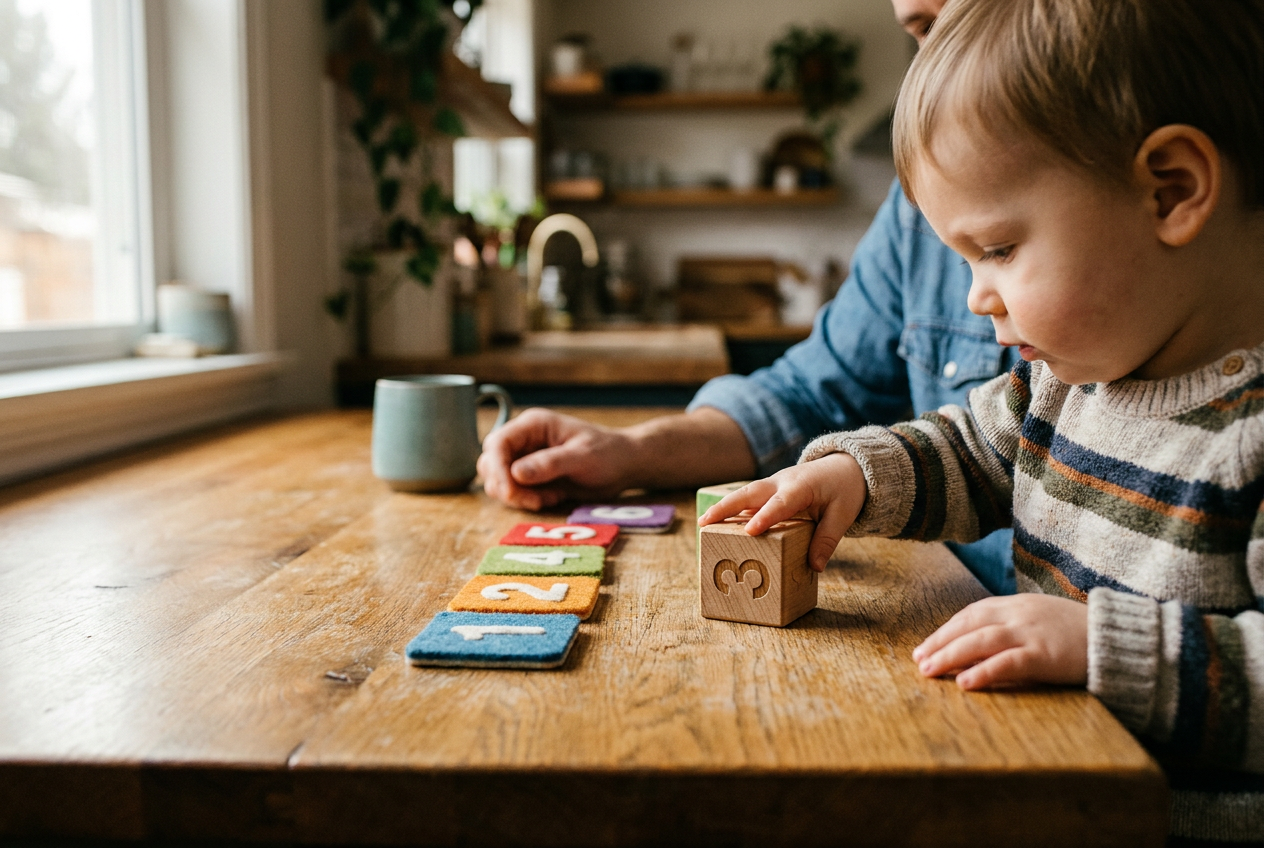
Watching your child learn to count is one of the first big milestones. It can also feel like a lot to figure out. How do you move past memorization to real number sense? You make it playful and fold it into the day. Early math matters more than most parents realize. A widely cited study in Developmental Psychology found that a child’s early math skills predict later school achievement better than any other early skill.
Most families use screens every day, and parents want that time to count for something. The American Academy of Pediatrics reports that most young children have access to a tablet or smartphone. Educational apps turn that access into real practice. Pair interactive games with hands-on activities, and you get a balanced approach that teaches counting.
Phase 1: Laying the Groundwork for Numbers 1-5
Start small. Before a child counts to 20, they need numbers 1 through 5 cold. This phase is about a solid foundation, not speed. The core idea is one-to-one correspondence: one number word for one object.
Step 1: Introduce Rote Counting Through Play
Rote counting means saying numbers in order from memory. It isn’t true counting yet, but it’s the first step. Make the sequence familiar and fun, like the alphabet song.
- Sing songs and rhymes: Work classic counting songs into your routine. “Five Little Ducks,” “One, Two, Buckle My Shoe,” and “Five Little Monkeys Jumping on the Bed” all repeat numbers in a way kids remember.
- Count in daily rhythms: Count the buttons on their shirt as you dress them. Count the apple slices on their plate. Count the stairs on the way to bed. The more they hear the sequence, the faster it sticks.
Step 2: Master One-to-One Correspondence
Here your child connects the number words to real objects. They touch one object for each number they say. This is a big cognitive leap, so give it patience and practice.
- Use fingers and toes: The best counting tools are always with them. Count their fingers one by one, touching each as you say the number. Do the same with toes at bath time.
- Count favorite toys: Line up a few toy cars, blocks, or stuffed animals. Count them together and move each one aside as you go. Start with three items and build up to five.
- Count snacks: Use crackers, berries, or puffs. Ask, “Can you count three grapes?” and help them touch each one as they say “one, two, three.”
Step 3: Connect Numbers to Their Written Symbols
Once your child handles verbal counting and one-to-one correspondence for 1-5, show them what the numbers look like. This links the spoken word (“four”) and the quantity (four dots) to the written symbol (4).
- Play with number puzzles and magnets: Wooden number puzzles and fridge magnets give kids something to hold. Let them grip the number 3 while counting out three blocks.
- Draw numbers together: Use sidewalk chalk, a whiteboard, or finger paint. Your handwriting doesn’t matter; familiarity does. Draw a big “2,” then draw two stars next to it.
Phase 2: Expanding the Count to 10
Counting to ten is a major milestone. This phase builds on the first five numbers and works counting into everyday activities. The focus is reinforcement and making counting useful.
Step 4: Weave Counting into Daily Routines
The best way to teach counting is to make it part of your child’s world. Look for natural chances to count together. It shows them numbers are everywhere and serve a purpose.
- Household chores: Give them small counting jobs. “Can you bring me six potatoes?” or “Let’s put eight books back on the shelf.”
- Setting the table: This is perfect one-to-one practice. Have your child count out the napkins, forks, or plates for dinner.
- Getting dressed: Count socks by twos, find ten buttons on a jacket, or count the stripes on a shirt.
Step 5: Play Fun and Simple Counting Games
Games turn practice into play and take off the pressure. Simple games reinforce number order, one-to-one correspondence, and even early addition.
- Board games: Any game with a die and a moving piece drills counting. Moving a token space by space reinforces the sequence.
- Number scavenger hunt: Hide seven toy dinosaurs around a room and have your child find and count them. For an easier version, ask them to spot the number “7” on a clock, book, or sign.
- “More or less” games: Start with a small pile of blocks. Ask, “What happens if we add one more? Let’s count!” That makes addition concrete.
Step 6: Introduce Visual Number Lines
A number line helps children see the sequence and the space between numbers. It turns an abstract idea into something they can point to.
- Create a floor number line: Use masking tape or chalk to lay out 1 to 10 on the floor. Have your child hop from number to number and call each one out.
- Use a printable chart: Print a colorful number chart and hang it in their room. Point to the numbers as you count together to tie the sequence to the written symbols.
Phase 3: Tackling the Tricky Teens (11-20)
The numbers 11 to 20 are the hardest. “Eleven” and “twelve” break the pattern, and the idea of a group of ten feels abstract. This phase breaks the teens into pieces kids can handle.
Step 7: Explain the “Ten and” Concept
The teens are just a group of ten plus a few more. Physical objects make this click faster than words.
- Use building blocks: Snap ten blocks into one tower and say, “This is a group of ten.” Set one loose block beside it: “Ten and one more makes eleven.” Repeat for 12, 13, and up.
- Try a ten-frame: A ten-frame is a grid of two rows of five squares. Fill one frame completely with counters or pennies, then start a second frame for 11 through 20. For 13, they see one full ten and three more.
Step 8: Reinforce with Movement and Music
Big numbers call for big movement. Physical activity anchors the sequence in memory and keeps kids focused.
- Count with action: Count to 20 during jumping jacks, claps, or foot stomps. The physical rhythm reinforces the verbal one.
- Play songs for 1-20: Find songs and videos built around counting to 20. Music and repetition carry kids through the tricky teens.
Step 9: Use Technology to Support and Engage
Well-built educational apps make counting to 20 feel like a game. They give instant feedback and teach new ideas in a low-pressure way.
- Interactive counting games: Apps like the Learning App for Kids give children guided activities where they tap and count animated objects. The app corrects gently and celebrates wins, which builds confidence.
- Layered learning: A good app teaches number sense several ways at once: songs, games, objects, and digital play. That mix builds real understanding instead of memorization, and it lets you track progress without formal testing.
Common Counting Challenges (& How to Solve Them)
Every child hits a few bumps on the way to 20. Spotting these common snags helps you give the right support at the right moment.
- Rote counting without understanding: Some kids recite numbers to 20 but can’t count a set of eight objects. Go back to basics with hands-on, one-to-one work on small groups.
- Skipping numbers: Kids often skip 13, 14, and 15. Stop and recount slowly together. Repetitive songs and number lines smooth out the skips.
- Trouble with the teens: If the “ten and” idea won’t click, spend more time with blocks or ten-frames. Build the numbers over and over until the pattern shows.
- A short attention span: Wiggling and wandering focus are normal at this age. Keep sessions to 5-10 minutes, tie counting to something the child already enjoys, and end on a win so it stays a game.
- Comparing your child to other kids: It’s easy to worry when a friend’s child counts higher. Children reach counting milestones on their own timeline, so measure progress against where your child was last month, not against another child’s pace.
How to Put Counting Into Practice
Teaching your child to count from 1 to 20 isn’t about drills or flashcards. It’s about a fun, supportive, number-rich home. Be patient, celebrate small wins, and count the world around you.
Use every tool you have, from fingers and toes to household objects and a solid app. Make counting part of talk and play, and you build the curiosity and confidence that carry your child into every math lesson ahead.
Ready to make counting an adventure? Download the Learning App for Kids today and watch your child’s love for numbers grow with fun, interactive games and guided lessons. Once counting clicks, children enjoy hearing that computers count too, just with far fewer digits.
Counting turns into arithmetic somewhere around five, and the guide for five year olds covers the shift from counting all to counting on.
Frequently Asked Questions (FAQs)
At what age should a child start learning to count?
Most children start the basics between ages 2 and 3. They begin with rote counting, memorizing the sequence, then develop a true sense of quantity and one-to-one correspondence between ages 3 and 4. Every child moves at their own pace.
My child can say the numbers but can’t count objects. What should I do?
This is common and means they have rote counting down but not one-to-one correspondence yet. Shift to hands-on practice. Have them touch each object as they say a number, or move objects from one pile to another as they count.
Why are the ‘teen’ numbers (11-20) so hard for children to learn?
The teens break the pattern kids just mastered. “Eleven” and “twelve” sound nothing like “one” and “two,” and the idea of a group of ten plus a few more is abstract. Use building blocks or a ten-frame to show that “ten and three makes thirteen” until the pattern clicks.
How can I tell if a learning app is actually effective?
Look for a few concrete signs: activities that adapt to your child’s level, a clean screen without constant ads or distractions, gentle feedback that corrects without punishing, and content tied to real early-math skills. The Learning App for Kids layers songs, games, and counting objects so children build number sense instead of memorizing.
What’s the next step after my child can count to 20?
Work on number recognition up to 20. Then introduce simple addition and subtraction with objects: “You have five blocks. If I give you one more, how many will you have?” It builds on their counting foundation.